Wednesday, 8 January 2014

drawing project on the wall. Assessment.

The work looked good on the wall and filled a whole section and I think the sculptures and shower panel added a third dimension to the project. 

Copy of my drawing statement:

'The term ‘journey’ references both my wanders around the area I live in and the progression of my drawing styles, which I’m still experimenting with.
The harsh black and whites of Robert Longo and David Bomberg and the messiness of William Kentridge inspired my final set of images.
The hidden areas most people avoid, or don’t know are there, are the places that interest me the most.
Discarded treasures, found amongst the dust and dirt of dilapidated barns, add a 3D element and become sculptural time capsules relating to the places they were found.
The shower door becomes a drawn photograph, recording the image straight through the glass as I looked directly at it.
These drawings are about abandoned spaces and redundant items.
Alberto Giacometti said, “The object of art is not to reproduce reality, but to create a reality of the same intensity”. This can be seen in my drawings where some are straightforward, easily identified, and others are more confusing demanding longer periods of reading to be fully understood.'

My feedback form from Andy said:
"You have worked with consistent energy this term and have developed a strong investigative approach to drawing. You need to keep this sense of drawing as being a vehicle of exploration during the self directed term. Recent drawings have a real sense of the uncanny in the ordinary. You have worked well with formatting your composition. Possible extremes of scale would be good for you. intensity is something you work well with'.

Grade B. 


'Recovered gas bottle study', charcoal on paper, 60cm x 95cm

'Crumbling barn roof study', charcoal on paper, 75cm x 90cm.
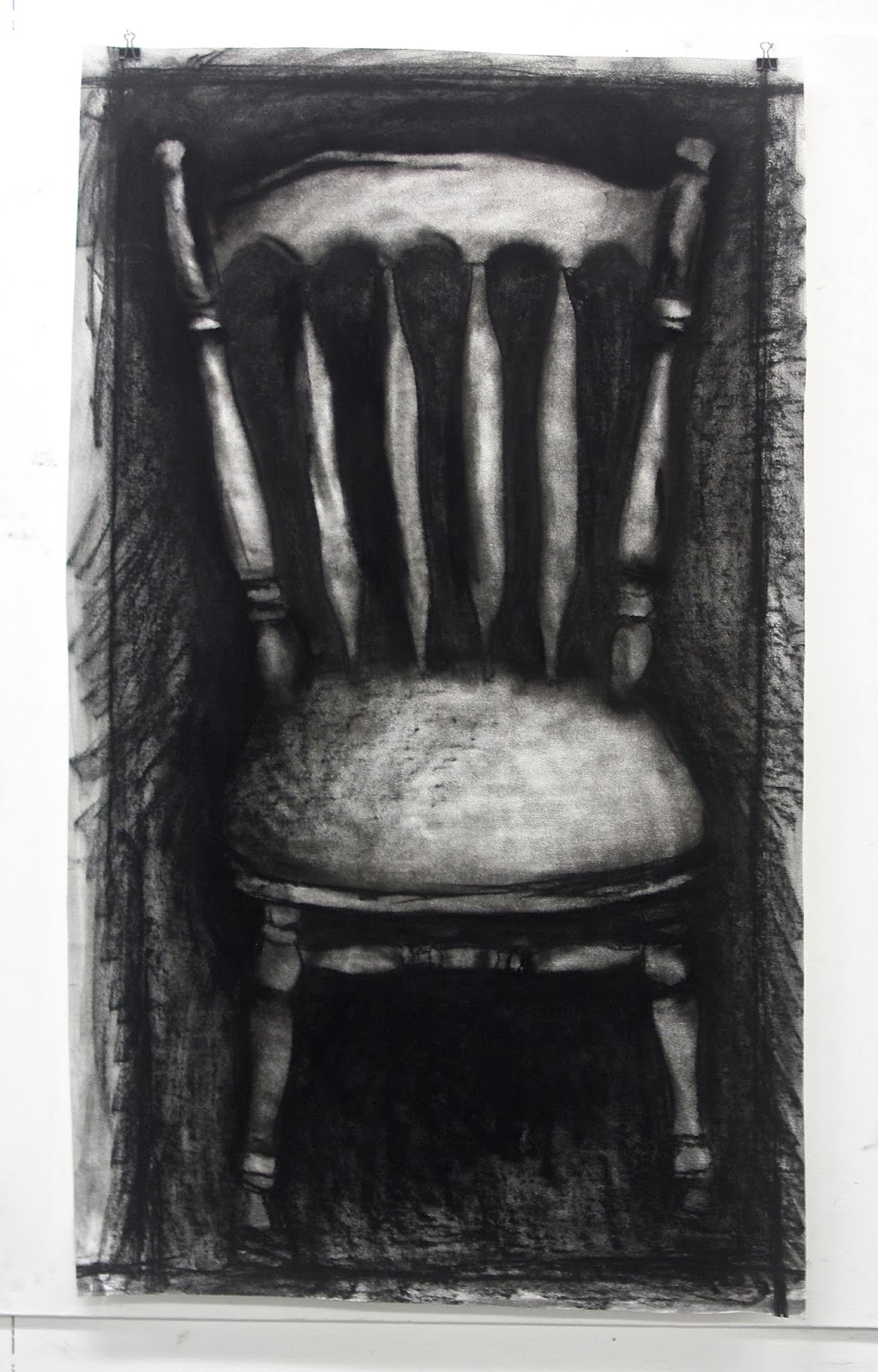
'Barn chair study', charcoal on paper, 120cm x 70cm.

'Barn finds' sculpture, recovered metal barn finds, 36cm x 12cm

'Thanks for the crap mate', mixed media on paper, 120cm x 60cm

'Bottle, Rope', recovered medicine bottle, rope, wood, candle. 22cm x 33cm x 12cm

'Barn Interior', recovered glass shower panel, marker pen, 140cm x 65cm. 

'Abandoned shack', mixed media, 120cm x 65cm. 

'Wander Accumulation', mixed media on paper, 83cm x 120cm.


Tuesday, 7 January 2014

feedback from print assessment.

"Very good commitment, enthusiasm a great approach to experimenting/playing.
The work has really developed but needs to be more focused and narrowed down. At this stage the work is very commendable. Aim for sharpness and clarity of ideas in future works."
Grade B.
Copy of my print statement:

The Arte’ Povera movement used recovered materials in their works and print artist Sehar Shah uses images collected through life to make prints. Through my renovation jobs I also collect and use abandoned materials.


The first piece is all about stories found in accumulated newspapers.
I’ve brought together an accumulation of portraits of people with the same goal in their lives and created what, as a group of people together, they were intending to create themselves.
The image is called “Explosion” and the portraits are 15 wanted terror suspects.
“We must erase these people from our world” was a headline above one of these portraits and lead me to the process of using an eraser to rub the image from the newspaper page and collect the debris onto clear tape and build an explosion using all 15 faces. Each piece of tape holds a different suspect. Closer inspection reveals subtle colours. Blood red, burnt black and green/brown earth colours all relate to the debris left after a real explosion. 

“Collective Individuality” looks at the idea of us all being exactly the same but completely different. The print is repeated over and over, made with the same face, but each has a completely different set of details, as do we.
Willie Cole does the same with his iron prints, which are all made with the same iron, but each print is unique.
The dispersion of the paint on the cloth changes with each application and slight differences in pressure, time and paint thickness gives each face its own distinct individuality. 

The last piece is something that grew from a set of electrical pylon prints and through experiments has ended as a sculptural piece in the same way as Eyal Gever creates 3D ‘prints’ where the pieces are formed and not restricted to the page. 
We worship technology and this makes us slaves to electrical power and
I like the idea of electricity having its own thoughts, breaking free from its surroundings and taking over.


'Explosion', paper, tape, erasings, 30 x 40cm.

'Collective individuality', Cloth, house paint, 120 x 75cm. 

Sunday, 5 January 2014

Fabrizio corneli

'Laboratorio' 1998, Iron, Varnish, Brass, Silver, Crystal, Dichroic Lamp.

Fabrizio Corneli creates installation pieces using light and the direct surroundings of wherever he installs the pieces. 
Without a light source his works do not show. They can't be seen. They remain hidden in the space. Light gives them life as it does to everything. 
'Laboratorio' shows his clever use of lighting and shadows. 
The tiny figure sits above the globe and, as light passes through, it becomes a silhouette projected onto the wall below.
The figure now appears to be walking towards the light or towards the source of its power. 
I really like this piece. It's build, theory, construction and overall simplicity all add together to make a striking image and the monotone forms and circular shapes give it a real strength.

Friday, 3 January 2014

Anselm Kiefer


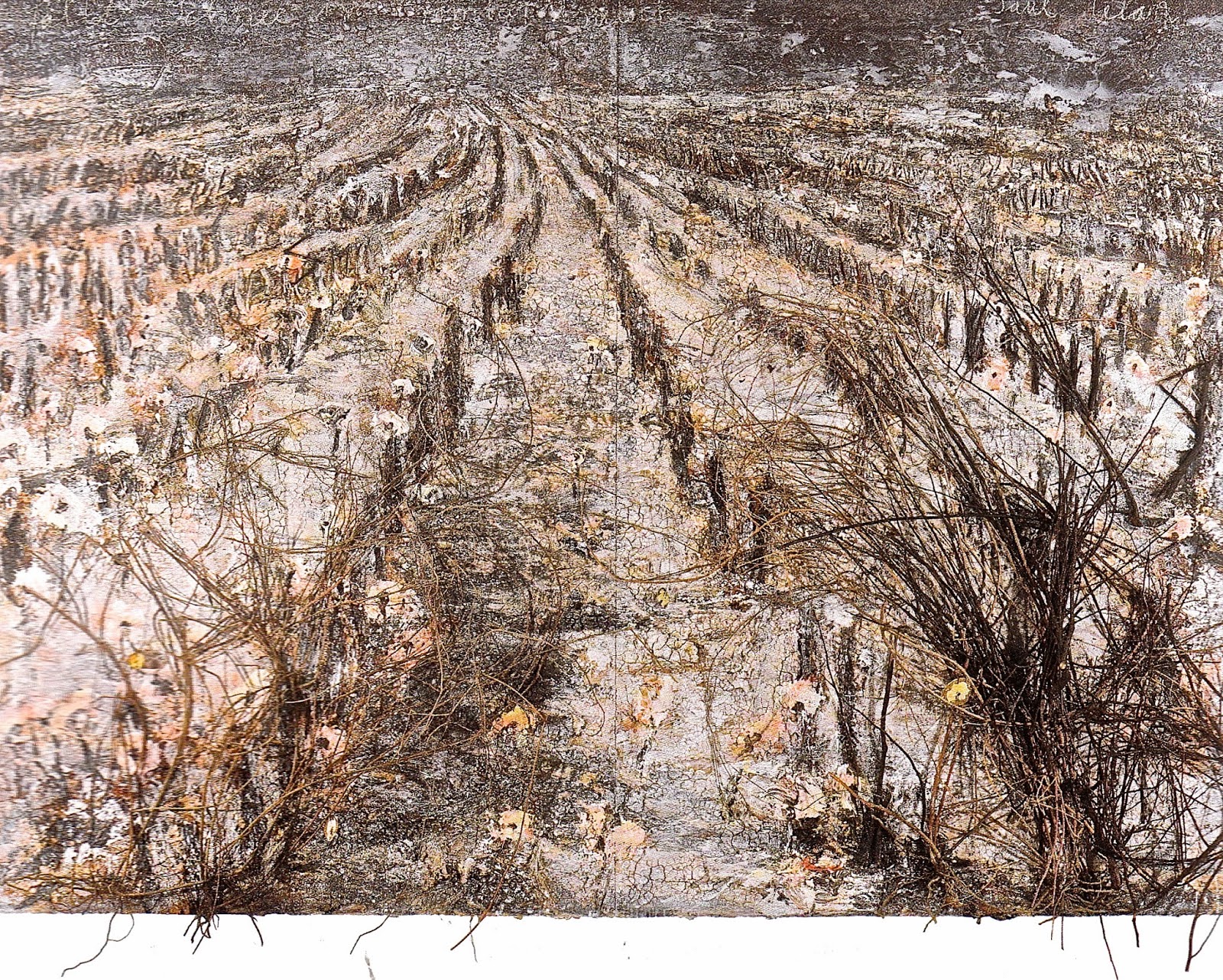
Anselm Kiefer's works are full of layers, textures, depths and history. His paintings almost rise off the canvas and some contain artefacts relating to the subject of the paintings. The way he draws with twigs, dust, lead, steel, dried flowers and even chairs really interests me as its something I've been looking at doing as part of my journey project. 


This image, 'Mulberry Bush', 2005, shows his use of other materials. As well as using oils, emulsions, acrylic and charcoal Kiefer has used brambles, hair and even earth in the final painting. But is it a painting or a sculpture made on canvas? Either way its full of inspiration to me. The way he makes the image disappear into the distance towards the dark sky and the tree stumps getting smaller give it great depth and the use of a real bush at the front really adds to this. 
Kiefer concentrates a lot of his paintings on the works of the poet Paul Celan and the issues and themes he wrote about. The paintings work as a visual reference to the poets works. In the above image you see Celan's name written across the top right hand corner. His poems influenced the artist massively. 


One painting that really stands out to me is 'The Only Light', 2005, 330 x 570 cm, painted with oil, acrylic, emulsion, shellac, wooden chairs, burnt twigs and lead boat. 
This enormous painting looks at the history of Germany, the holocaust and the end of the war. The image seems to suggest rows of graves or bodies and the cold snow/ash covered grey earth suggests something or someone being burned. The barren landscape is both beautiful and saddening to look at. 


Friday, 27 December 2013

Print..final pieces for assessment...

The Arte' Povera movement concentrated their artworks on materials found or recovered from wherever they could get them. My materials have been accumulated from various jobs I've done on domestic properties in the last few months. Newspapers, materials, paints, woods, metals etc have been collected and stored with the idea of using them in the future to produce pieces.
I've especially used them in my printing work as they lend themselves perfectly to the notion of experimentation.
All of my final assessment pieces have been produced with mostly recovered stuff.


This first piece came from experiments I've been concentrating on in my accumulation and dispersion project. I wanted to make something that expressed an idea but in a non print medium, something with levels and layers of both production and idea.
The idea was to build an image relating to the theme of a set of images found in daily newspapers.
I realised when looking through my pile of accumulated newspapers that we see the same types of stories over and over but with different people filling the images. Same theme, different person. I decided to concentrate on a specific set of stories that seems to be appearing more and more in our news.
I've brought together an accumulation of portraits of people with the same goal in life and created what, as a collective group of people, they were actually intending to create themselves.

The image is called "explosion" and the portraits I used were of 15 wanted terror suspects.


                                      "Explosion", 30 x 40 cm, paper, tape, eraser rubbings. 

One of the headlines accompanying a portrait of one of the suspects read "We must erase these people from our world" and I wanted to use this idea in my work.
The process involved collecting a set of portraits from newspapers and erasing the images with a rubber eraser until the face had disappeared from the page.
The debris from the eraser is collected on clear tape then laid onto a new piece of paper to create a completely new image made up of the collective portraits from the newspapers.
The random dispersion of the debris is completely out of control and relates to previous works of mine where I was looking at controlling a process but not an outcome.
The image is loaded with detail and texture, built from the layer of rubbings attached to the surface of the paper.
Closer inspection reveals a subtle collection of different colours. Blood red, burnt black and green/brown earth colours all relate to the debris left after a real explosion.
The choice to use white background paper was a conscious decision as it reminds me of the smoke and dust seen in images of terror attacks.

                                                detail from "Explosion" 

Each of the 15 different pieces of tape has captured a different portrait and bringing them together creates a simple yet complex print which engages the viewer and points them towards an important social issue of today. 


This next piece was arrived at after a lot of playing with a print idea I'd had relating to the way we are all the same but completely different and as individuals we can easily become lost in the crowd populating the world today.
I wanted to create a print with one face repeated over and over but with different details each time. The features stay the same but the face never looks the same, echoing our own faces.
The dispersion of the paint on the cloth changes with each application. Some are soft edged, almost happy looking, others hard and direct with a sinister glare, but each very individual.

"collective individualism", paint on cloth, 120cm x 75cm

I tried to make the centre face as clear as possible to become a focus point in the print which the eyes can return to after studying the mass of faces staring back at us. 
I don't know if its possible but I'd like to carry on with this idea and somehow make the individual faces move slightly, maybe through a projection, to add a whole new feeling to the piece.


This last piece is something I've experimented with several times throughout the first term as you can see from previous blog pages.
Looking at accumulation and dispersion I started to build a piece that used collected materials along the lines of the depletion of fossil fuels and the dispersion of electricity.
I realised I've been trying too hard with this piece and started over again with the goal of not overcomplicating things but just making a piece of art that I like but still show the idea of the electricity breaking through the wire and dispersing around us or breaking free.
I'm pleased with this finished piece now and the fact that extensive experimenting means its ended up as a sculpture, from a print class, pleases me even more.  

'Untitled', recycled wood, cable, mesh, electrical components.


Tuesday, 24 December 2013

print work scrap book...

Pages from my print scrapbook....


All from the Accumulation and dispersion project...

Splatter images...

Accumulation of 'trash and rebuild'...


Looking at the dispersion of electricity...


Collecting images and re-printing the detail over the top through clear plastic...

printing the 'loss of identity' images onto canvas....


Taking eraser rubbings from newspaper images and building a collective image on single pages....

Loss of identity print...'We all die the same'...

Saturday, 14 December 2013

Drawing...Reflective surface...

The mirror was found in the same place as the glass shower panel. Standing it upright on a ledge I could close one eye and draw the image as it reflected on the mirror surface. 
The slightest shift in position makes the image move on the mirror so it has to be drawn speedily with minimal movement and simply looking away for a moment whilst drawing, then back again, adds a satisfyingly distorted element to the final image.
Mirror Drawing,  30x40cm, marker pen on found mirror.

As a viewer, standing in front of the mirror, you are transported to the place It was created and through the reflection you get to see yourself, trapped in the image, there in the barn, looking at what I was looking at. A sort of 'here and there at exactly the same time" element being added to the piece. 


The reflection can also be used to project the drawing onto another surface, creating a soft, transparent, ghostly image.