Friday, 17 January 2014

Street photography...

I've always liked the way images can sometimes present themselves to you if you just keep your eyes open and look for interesting images from everyday situations in the real world.
The urge to make photographs always make me head in a different direction. Sometimes I'll change my route and head a different way. If an alleyway looks interesting or dirty or an open door presents itself or a building looks derelict, I'll be drawn towards it.
This kind of work, Street photography, has been around as long as camera's have been available and just a simple walk can throw up endless possibilities for the photographer.
I like the grittiness of the phone images and the way it adds definition and grain and the over-saturation of the colours.
Its a project that I've just started and I want to carry on with it, grabbing interesting images with my phone as I walk past them in the street. Its a simple project as far as carrying it out goes, the only thing holding back a street photographer is the fear of actually taking the shots,
"If your photo's aren't good enough, your not close enough" Robert Capa.
I need to narrow it down and choose a subject matter to concentrate on as the project builds and aim towards a set rather than a random selection.
The colours, textures, people, situations and environment of the city of Leicester need to be explored, recorded and documented for my own satisfaction.




Tuesday, 14 January 2014

William Kentridge "Try not to fail, Then work with the failure".

After completing my drawing project I was interested in researching other charcoal artists and discovered the work of the artist William Kentridge.
Inspired by his home country of South Africa he looks at the social aspects of life in the country and how it affects the people who live there.


William Kentridge, Drawings for "Other Faces" animation. 
His drawings are the foundations for his animation works and he photographs each image at different stages of drawing then imports them as stills into the films. As he does this he alters each drawing, rubbing bits out, smudging areas, highlighting, darkening and adding new areas. This technique makes the drawings shadowy as they are filmed and the charcoal leaves a ghostly image even when rubbed out which adds a layer of history to the films. 
This is kentridge's style and it appealed to me because it relates to the work I produced for my drawing project where I made charcoal drawings of my local area but with a look of darkness, suspicion and chaos.

His images are dramatic and tell stories even before they become part of his films and they all have a certain dark mood to them. 
In his film "Felix in Exile" we see the artists own style in full force. Things he's witnessed first hand or looked at in newspaper reports inspire the dead people bleeding from different areas of the body, harsh landscapes and expressionless faces which fill the screen. His films are full of shock as well. In "Pain and Sympathy"we witness several acts of violence with people being beaten up, axed, stabbed and kicked in the head but its the way he then shows the battered skull as an x-ray with red crosses marking the points where the booted foot was kicking him that makes the film brilliant. As the car travels along the road we see ghostly figures trying to escape from something until finally the car hits someone and their terrifying head smashes through the windscreen and wakes the dying man in his hospital bed. An excellent piece of inspirational and technically brilliant art.
The accompanying soft, confused music and sounds gives a feeling of reliving a dream, or nightmare. The films are all about emotions, thoughts, death, violence and the acts of humans affected by apartheid.

In his drawings and prints Kentridge uses white highlights which serve the purpose of darkening the black within the scene and these dark areas then draw our eyes into the important areas of the drawing. I use the same technique in my images and use white paint to give the drawings added depth and perspective. 
Willaim Kentridge, Drawing for the opera the magic flute, 2005

The works appear to be statements of social happenings in the history of South Africa and how the artist sees it himself.  
His use of strong, direct lines and constant re-drawing of each picture creates unique films which relate the idea of stories in a gritty, ghostly way. 

His personal history tied in with the history of his home have given him the tools he needed to create these great pieces of art. 

Kentridge says of his drawing "It isn't a decision, Its a need" and I think what he's trying to say is he needs to draw. He needs to make artworks in the way an alcoholic needs to drink alcohol. Reading his interviews he definitely comes across as someone addicted to making marks on paper. 


Monday, 13 January 2014

Lens Based Assessment.

Clifton said;
"An overall good, researched and well thought out set of projects that work well. The content is clear and research and reference supports the pictures well. Do keep pushing the experimental works and the blog is good and very well presented".

Grade A.

My statement:
"My photography is very broad based and I try to make images that tell a story or project a feeling to the viewer. I like the idea of them looking like stills from movie sets.  I’m interested in everything that presents itself to me including the streets I walk along, the people I see and the environment that we inhabit.

My range of Inspiration is as wide as my subjects.  The quirky portraits of Annie Liebovitz, the fashion inspired sexy style of Albert Watson, the dark grittiness of Don McCullin and the sheer beauty and grace of Jean Loup Sieff all push me to make new photographs and experiment in different subjects and styles.
I’m inspired by anyone that uses photography as a means to produce interesting images or movies. I’ve recently started to integrate black and white photographs into my paintings and drawings and want to carry on with this idea in future projects".


Wednesday, 8 January 2014

drawing project on the wall. Assessment.

The work looked good on the wall and filled a whole section and I think the sculptures and shower panel added a third dimension to the project. 

Copy of my drawing statement:

'The term ‘journey’ references both my wanders around the area I live in and the progression of my drawing styles, which I’m still experimenting with.
The harsh black and whites of Robert Longo and David Bomberg and the messiness of William Kentridge inspired my final set of images.
The hidden areas most people avoid, or don’t know are there, are the places that interest me the most.
Discarded treasures, found amongst the dust and dirt of dilapidated barns, add a 3D element and become sculptural time capsules relating to the places they were found.
The shower door becomes a drawn photograph, recording the image straight through the glass as I looked directly at it.
These drawings are about abandoned spaces and redundant items.
Alberto Giacometti said, “The object of art is not to reproduce reality, but to create a reality of the same intensity”. This can be seen in my drawings where some are straightforward, easily identified, and others are more confusing demanding longer periods of reading to be fully understood.'

My feedback form from Andy said:
"You have worked with consistent energy this term and have developed a strong investigative approach to drawing. You need to keep this sense of drawing as being a vehicle of exploration during the self directed term. Recent drawings have a real sense of the uncanny in the ordinary. You have worked well with formatting your composition. Possible extremes of scale would be good for you. intensity is something you work well with'.

Grade B. 


'Recovered gas bottle study', charcoal on paper, 60cm x 95cm

'Crumbling barn roof study', charcoal on paper, 75cm x 90cm.

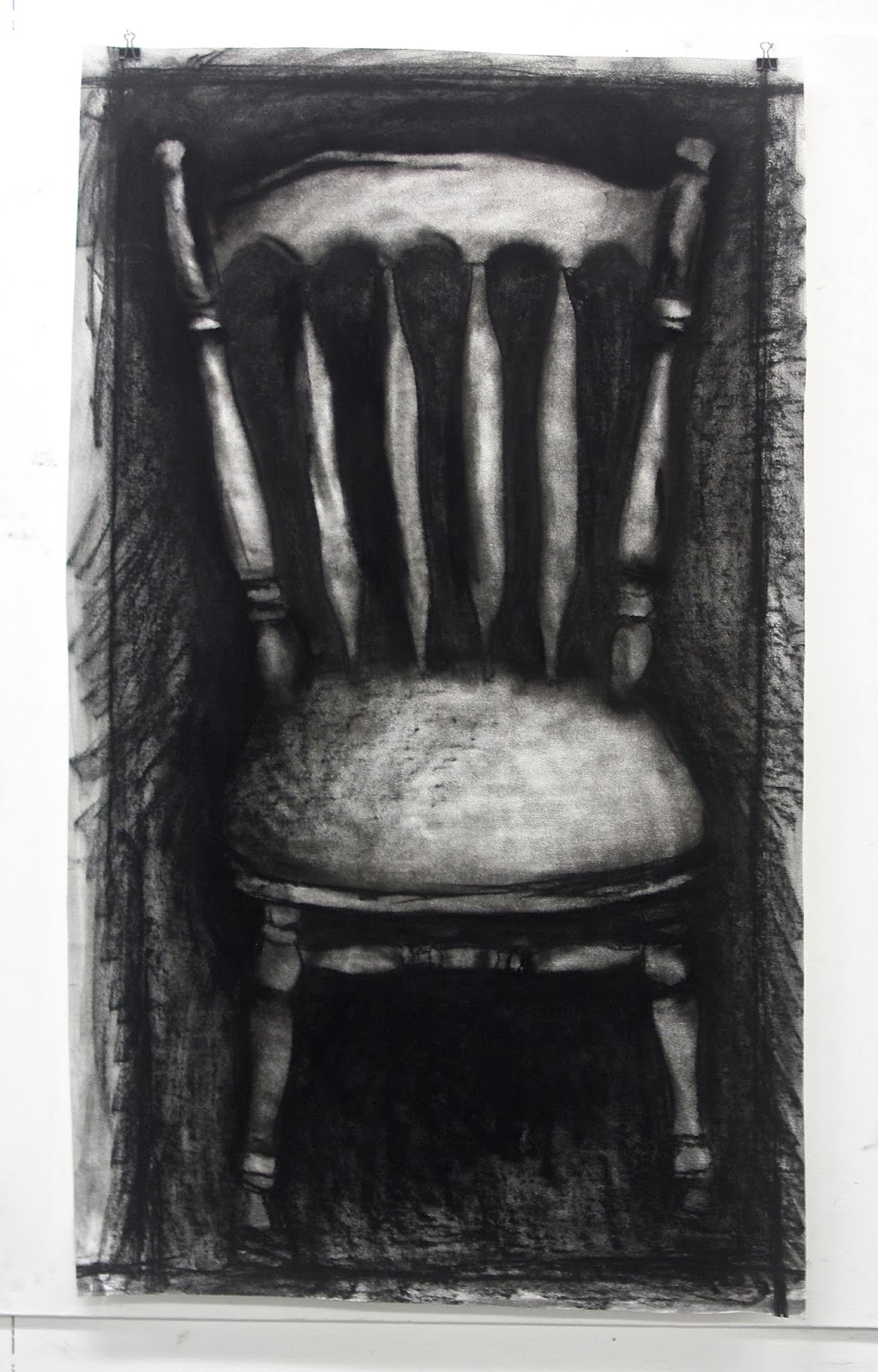
'Barn chair study', charcoal on paper, 120cm x 70cm.

'Barn finds' sculpture, recovered metal barn finds, 36cm x 12cm

'Thanks for the crap mate', mixed media on paper, 120cm x 60cm

'Bottle, Rope', recovered medicine bottle, rope, wood, candle. 22cm x 33cm x 12cm

'Barn Interior', recovered glass shower panel, marker pen, 140cm x 65cm. 

'Abandoned shack', mixed media, 120cm x 65cm. 

'Wander Accumulation', mixed media on paper, 83cm x 120cm.


Tuesday, 7 January 2014

feedback from print assessment.

"Very good commitment, enthusiasm a great approach to experimenting/playing.
The work has really developed but needs to be more focused and narrowed down. At this stage the work is very commendable. Aim for sharpness and clarity of ideas in future works."
Grade B.
Copy of my print statement:

The Arte’ Povera movement used recovered materials in their works and print artist Sehar Shah uses images collected through life to make prints. Through my renovation jobs I also collect and use abandoned materials.


The first piece is all about stories found in accumulated newspapers.
I’ve brought together an accumulation of portraits of people with the same goal in their lives and created what, as a group of people together, they were intending to create themselves.
The image is called “Explosion” and the portraits are 15 wanted terror suspects.
“We must erase these people from our world” was a headline above one of these portraits and lead me to the process of using an eraser to rub the image from the newspaper page and collect the debris onto clear tape and build an explosion using all 15 faces. Each piece of tape holds a different suspect. Closer inspection reveals subtle colours. Blood red, burnt black and green/brown earth colours all relate to the debris left after a real explosion. 

“Collective Individuality” looks at the idea of us all being exactly the same but completely different. The print is repeated over and over, made with the same face, but each has a completely different set of details, as do we.
Willie Cole does the same with his iron prints, which are all made with the same iron, but each print is unique.
The dispersion of the paint on the cloth changes with each application and slight differences in pressure, time and paint thickness gives each face its own distinct individuality. 

The last piece is something that grew from a set of electrical pylon prints and through experiments has ended as a sculptural piece in the same way as Eyal Gever creates 3D ‘prints’ where the pieces are formed and not restricted to the page. 
We worship technology and this makes us slaves to electrical power and
I like the idea of electricity having its own thoughts, breaking free from its surroundings and taking over.


'Explosion', paper, tape, erasings, 30 x 40cm.

'Collective individuality', Cloth, house paint, 120 x 75cm. 

Sunday, 5 January 2014

Fabrizio corneli

'Laboratorio' 1998, Iron, Varnish, Brass, Silver, Crystal, Dichroic Lamp.

Fabrizio Corneli creates installation pieces using light and the direct surroundings of wherever he installs the pieces. 
Without a light source his works do not show. They can't be seen. They remain hidden in the space. Light gives them life as it does to everything. 
'Laboratorio' shows his clever use of lighting and shadows. 
The tiny figure sits above the globe and, as light passes through, it becomes a silhouette projected onto the wall below.
The figure now appears to be walking towards the light or towards the source of its power. 
I really like this piece. It's build, theory, construction and overall simplicity all add together to make a striking image and the monotone forms and circular shapes give it a real strength.

Friday, 3 January 2014

Anselm Kiefer


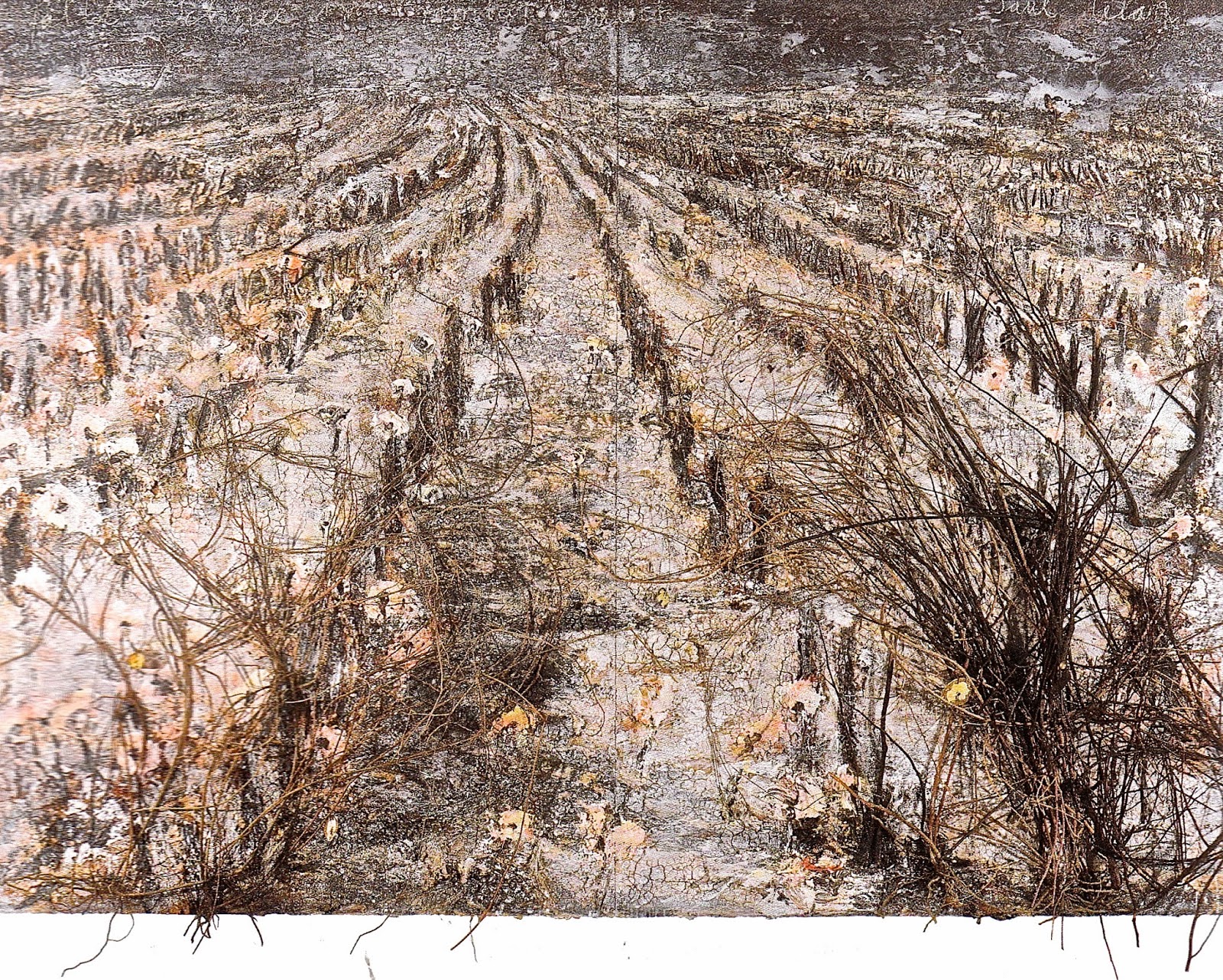
Anselm Kiefer's works are full of layers, textures, depths and history. His paintings almost rise off the canvas and some contain artefacts relating to the subject of the paintings. The way he draws with twigs, dust, lead, steel, dried flowers and even chairs really interests me as its something I've been looking at doing as part of my journey project. 


This image, 'Mulberry Bush', 2005, shows his use of other materials. As well as using oils, emulsions, acrylic and charcoal Kiefer has used brambles, hair and even earth in the final painting. But is it a painting or a sculpture made on canvas? Either way its full of inspiration to me. The way he makes the image disappear into the distance towards the dark sky and the tree stumps getting smaller give it great depth and the use of a real bush at the front really adds to this. 
Kiefer concentrates a lot of his paintings on the works of the poet Paul Celan and the issues and themes he wrote about. The paintings work as a visual reference to the poets works. In the above image you see Celan's name written across the top right hand corner. His poems influenced the artist massively. 


One painting that really stands out to me is 'The Only Light', 2005, 330 x 570 cm, painted with oil, acrylic, emulsion, shellac, wooden chairs, burnt twigs and lead boat. 
This enormous painting looks at the history of Germany, the holocaust and the end of the war. The image seems to suggest rows of graves or bodies and the cold snow/ash covered grey earth suggests something or someone being burned. The barren landscape is both beautiful and saddening to look at.