Seminar Presentation February 2014.
My feedback from Jamie was quite positive and he quoted on me giving a good clear presentation and engaging with the audience. He quoted that I could relate the work further to older generations but as part of the presentation I'd already talked about the first Bonsai tree art found in a temple in the year 706 and the ancient Chinese art of Thick stroke painting.
The other feedback sheets had a common theme mainly stating my presentation was engaging, well explained, good historical content, well researched and showing a good level of knowledge of the subject.
Personally I think my presentation was a good experience for me and my peer group. I try to engage the audience as much as possible, pointing out relevant details in the images, talking towards the group as opposed to the piece of paper in my hand and keeping the whole thing moving at an understandable but not boring pace.
I researched the artist thoroughly and concentrated more on the work and its meanings than on the artists biographical details.
I gave a full but brief insight into the build of the piece and what happens to the sculptures after the show is closed.
I spoke of the reasons behind the work, its relation to the environment, inspirations, historically related works, modern related works, religion and also highlighted artists working in the same way as Yamamoto.
I could have improved my presentation by maybe sticking more to what I had written than just talking to the group but I find myself easily distracted from the script when I like the artist I'm talking about.
I think the presentation, research and written copy deserves an A grade;
Shinji Yamamoto
"Hanging Garden", Site Specific Sculpture, Cincinnatti.
‘Hanging Garden’ is a site specific
installation built in an old chapel in Cincinnati.
It sits in the centre of the 19th
century renaissance revival building, which was deconsecrated in the 70’s, but
still stands at the top of a place called mount Adams.
The building now sits empty and the
dilapidated look of the interior, colours of the walls, the flaky paint, holy
symbols and fall of natural glorious sunlight streaming through the windows, all play their
own part in how we see this sculpture, possibly as a spiritual piece of art.
The surroundings set the scene for the
artwork and the once derelict building has since been reopened as a gallery and art space giving other artists the opportunity to show their work.
The installation is constructed from a
living tree sitting on top of a dead tree. Both trees are twined together at
the roots, making them into one single piece, but separated by death.
The living tree looks healthy and alive with glowing white bark and branches covered in green leaves whereas the dead tree hangs upside down, all the
leaves are gone but it serves the purpose of suspending the living tree above
the ground, pushing it upwards and making it appear like a religious icon or a
cross in the centre of the church.
In the centre, where the roots meet, is a
small patch of earth, alive above, dead below.
He states;
‘The uprooted tree supports
the soil which is necessary to support the life of the living tree, creating a
suspended garden’.
A sophisticated watering system has been
set up to feed the roots and keep the top tree alive throughout the exhibition
and the tree will be returned to its original place and replanted once the show
is finished.
By placing the trees in the centre of
the church the artist has made it into an alter piece, replacing the alter that
stood there originally with something grand that makes a statement.
The piece brings new life into a dead
place and something we see everyday, trees, now take on a whole new meaning.
Once he’s finished with the trees or
whatever materials he uses, he returns them to a place where they can be
re-used to make new pieces of art by other artists or the trees get replanted
in the place they originally came from.
Either way he uses natural materials
which are reused and recycled.
Yamamoto does this with a lot of his
work. He looks at life and death, the state of the earth and the human effect
on the planet. He creates pieces that show us what he sees around him.
He builds from personal experiences and
his own reactions to the landscape around him and places this into each piece
of work.
He concentrates on the effects of nature
on humans, and the effects of humans on nature.
The connections between Mankind and
nature have a massive effect on all of his works and everything he makes relates to the
world around us, and how we see it, in one way or another.
Tang Wall painting, year 706.
Yamamoto's inspiration and influence comes from his background in China and the artists working in the old spiritual style. Eastern artists have been looking at nature, spiritualism and trees for inspiration throughout the history of art. This image shows a wall painting discovered in the Tang Dynasty tomb dating back to the year 706 and is the first recorded image of a bonsai tree being grown as a sculpture. Bonsai is all about contemplation, the spiritual state of the tree and is regarded as long term meditation which takes years to develop.
Yamamoto's works are contemplative, spiritual and meditative.
The old eastern paintings produced using "Thick stroke" techniques were made to convey spiritual resonance with the simplest of strokes being made on the paper, without highlighting the forms or shapes of anything real. They were made to show the creators feelings and beliefs rather than specific realities.
Environmental awareness in art
Environmental issues are highlighted in the above image.
In China 45 billion pairs of disposable chopsticks are used each year which equates to around 25 million trees and this piece, a fallen tree made from chopsticks, was created to highlight this issue and raise public awareness, something Yamamoto is a specialist of.
Environmental art is very big at the moment. Artists around the world are always looking at ways to get the environmental message across and make statements with regard to our situation on the planet.
French Graffitti artists Painting.
This work is by a french graffiti crew and the message reads "sorry for the tree but we need more place" relating the message that as humans we think we can basically do what we want to the planet and our surroundings, which is what Yamamoto is against.
His work is about the environment but is more aimed towards the spiritual side of nature whereas this piece looks at the immediate effect man is having on the planet but both speak in an environmentalist language.
The artist 'Christo' wraps exterior environments in see through materials, capturing and protecting the things inside in gloriously extravagant installations which are both interesting and intriguing to see. The pieces have included wrapped buildings (The Riechstag), whole coastlines including the rocks and beach and vast expanses of fences which run for miles in the landscape. These see through tree sculptures are my personal favourite though. They have a real dream like appearance and the shafts of sunlight burning through the material gives them a surreal glow that brings them to life.
Christo, Switzerland, 1997.
Shinji Yamamoto uses materials from locations of previous artworks such as bits of plaster and dust from the walls of the church that the tree sat in.
His series of dust installations are very delicate, quiet, contemplative spaces made from dust dropping onto small piles and building up through a period of time. The artist uses a shaker to slowly drop the dust through and then brushes the dust from certain areas with an ancient Chinese brush tool. This tool again shows his inspiration coming from ancient art practises such as the design and build of Zen Gardens. These gardens were made and maintained in a search for perfection and the artists making them would use small brushes and rakes to remove any unwanted debris, leaves etc from the garden areas. The dust installations are Yamamoto's Zen Gardens and he revisits them during the exhibition to ensure they stay perfect.
Looking at this piece I get the impression that the little islands of stone are the earth and the dust is the build up and over population of humans on the planet but thats just what I think, the actual meaning may be something completely different but I couldn't find an explanation anywhere.
Either way the installation looks really beautiful and opens my eyes to what can be done and said in a piece of art.

"Dust" Installation Piece in Ireland.
One quote I read explained his ideas perfectly:
“Through
his work he takes us away from the idea of an anthropocentric existence and
points us towards a holistic view”.
I looked up the meanings of this statement;
Anthropocentric translated means
“regarding humankind as the central or most important element of existence”, This is
basically the idea that humans are the most important thing in the universe.
Holistic means “The belief that the
parts of something are intimately interconnected” so this actually means we are in some way
connected to nature and everything in the universe, all things have a spirit and should be valued equally.
Yamamoto tries to show his belief that man and
nature is one and interconnected:
“With my installations, sculptures and
paintings I work with this universal and identifiable tree/nature imagery to
encourage audiences to encounter and engage aspects of nature in a new way. The
work explores a poetic reunion with nature, making visible connections and
similarities between plant life and humanity, emphasizing ecological wisdom and
the interconnectedness of all life.
They illuminate our mutual destiny and
the precarious beauty of this relationship”.
This piece titled “Sleeping Vishnu Tree” came
after the artist walked through a park and saw a tree fallen to the ground. A
few days later all that remained was the hole where the tree came from.
Inspired by this scene Yamamoto painted an image of the tree in Henna liquid as
it ‘reminded him of the smell of a forest’.
In the image he uses gold leaf to create
small leaves that suspend the tree from the ground almost as if the tree is
being carried off to somewhere new in the way a coffin is carried at a funeral. It resembles the Buddhist statues seen in temples across the world and could almost be a ghostly version of one.
Buddhist statue, China.
The sweeping shape of the body and head is highlighted in both of the images as are the flowers around the lower part of the figure.
He says:
“I wanted the tree to lie and sleep,
envisioning a new world, like the dream of the world that emerges from the
naval of the Indian god Vishnu in the form of a lotus flower”.
"Rainbow" Steel, Paint, Rainwater.
In a series of rainbow paintings he worked with rainwater, ash and soot found in the location of the paintings and bits of sheep’s wool that were captured in farmyard fences. These paintings were made in Ireland and he says he saw rainbows almost everyday which inspired him to create the paintings but he didn't just want to paint them, he wanted to create them, or let them be created, using the elements of the weather and the nature of the surrounding location.
He works together with nature to create his artworks.
Religion also plays a big part in his
creations and he uses holy statues, Buddha’s and religious symbols in his pieces to
relate this and show his beliefs. His installation spaces are quiet. Places
where people can go and sit, meditate and Ponder the artworks and the
surroundings and how it relates to their lives. Each space could easily be mistaken as a shrine or temple.
This installation in Ireland was made with recovered bits of the church walls.
"Petals of the universe" Compressed Flower Material.
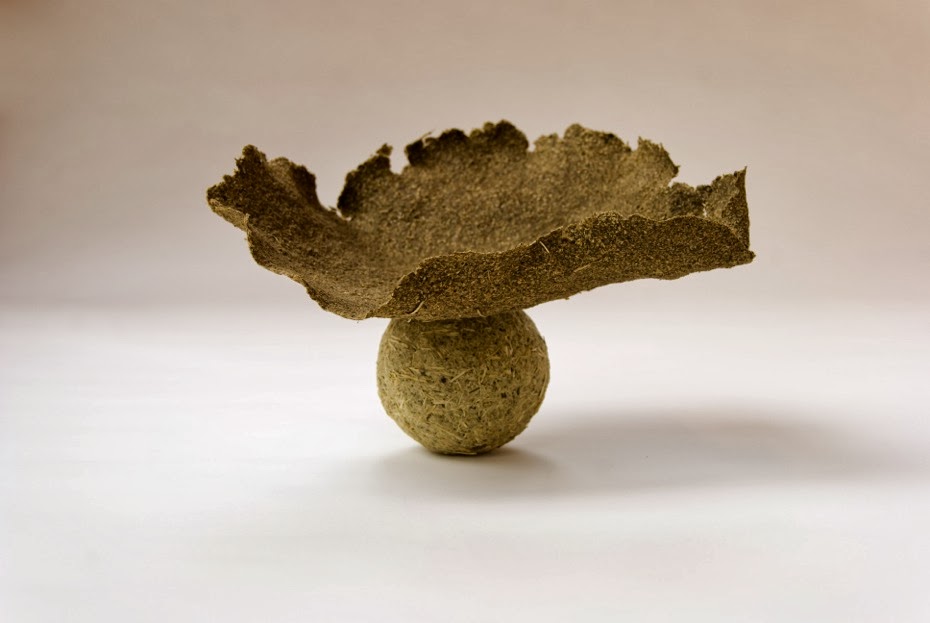
His extremely delicate ‘Petals of the universe’ sculptures
were made by applying very high pressures to small fibres of plant material
which, when dried out, start to take on a new form or shape and resemble the
shape of the original flower blossoms.
He says of the pieces, again looking at the world around us, the whole process reminded him
of the way rock is formed inside the earth from pressures underground. Avery natural sculpture made in a very natural way.
These small sculptures again form themselves
with little or no help from the artist.
This is his whole belief when it comes
to making art.
Using things that sometimes will not
relive, but will sometimes take on a new life, created through his own thoughts and
creation processes, driven by his passion for the spiritual side of the environment.
Each thing becomes something else,
something new and is either alive or a record of the life it once had.
I looked at several different environmental artists who also use this idea of
taking nature and its inhabitants and using it to create new works of art.
Jaako pernu creates large artworks using
natural materials.
He creates installations using trees, which, once the
exhibition is finished are moved outside to a new space where the piece is left
until it degrades through the forces of nature. In doing this he returns the
tree back to its place as part of the earth in the same way yamamoto does with
his trees.
Robert Smithson, Mathilde Roussel, Andy Goldsworthy and Nils Udo are all looking at nature and the environment to create their works.
"Andy Goldsworthy" uses materials found outside to create his site specific pieces of sculpture.
He works on land and also in water and always uses whatever he's stumbled across in the location he's in.
"Mathilde Roussel" creates these falling figures which look as though they continue to grow in the gallery space. This piece reminds me of an exhibition I went to in Leicester in a disused factory and in one of the old, dark, dusty production rooms was a full field of fresh grass to walk across. It was really surreal situation with this natural thing growing in a completely unnatural environment.
"Nils Udo"
I like this sculpture but it works in a very different way when compared to Yamamoto as the trees look as if they've been cut down to create the work rather than being recovered and recycled. If this is the case then the trees have been killed and their spirits lost and it would be interesting to hear what Yamamoto's thoughts on this piece would be? It's environmental art because its outside in the environment but is it environmentalist art? Is it trying to relate a message or is it simply a sculpture in the woods?
Shinji Yamamoto looks at the world through environmentalist eyes. He creates works that try to make us understand that there is a connection between humans and nature and he makes us aware of the dangers mankind is forcing onto the earth. His art is very 'up to the moment' and in-keeping with what's happening to our environment. He shows us the idea that everything has a spirit or a soul and he does all this through his art.
His work is beautiful, inspirational and meaningful.


.jpg)